

Introduction
Building a digital product today is not just about having a great idea. It is about launching quickly, validating demand, and improving based on real user feedback. This is where the concept of a minimum viable product becomes essential.
A minimum viable product is one of the most widely used strategies in modern software development and startup product development. Instead of investing months or years building a fully featured platform, companies release a simplified version of the product first. This early version contains only the core features required to test whether the idea works in the real market.
For startups, this approach reduces risk, shortens the application development life cycle, and keeps app development cost under control. Many of today's successful platforms started with a simple MVP before evolving into the complex products we know today.
In this article, you will learn what an MVP is, why it matters, how it fits into the app development lifecycle, and how companies use it to build successful digital products.
What is a Minimum Viable Product
The minimum viable product is a concept popularised by the Lean Startup methodology. It refers to a product version that includes only the essential features required to deliver value to users and collect meaningful feedback.
If you are wondering what is MVP or what is an MVP, the answer is simple. It is the earliest usable version of a product that allows you to test your idea in the market with minimal development effort.
Instead of building a complete product immediately, teams focus on a minimal viable product that solves one clear problem for users.
A well designed MVP allows you to:
Validate your product idea with real users
Reduce app development cost
Launch faster in a competitive market
Identify what features users actually need
Avoid building unnecessary functionality
In minimum viable product software development, the goal is learning rather than perfection. Each iteration of the product improves based on user data and feedback.
This approach is widely used in web app development, mobile applications, SaaS platforms, and digital platforms created by startups.
MVP Full Form in Project and Product Development
Many people search for the MVP full form in project discussions or product planning meetings. The term MVP stands for Minimum Viable Product.
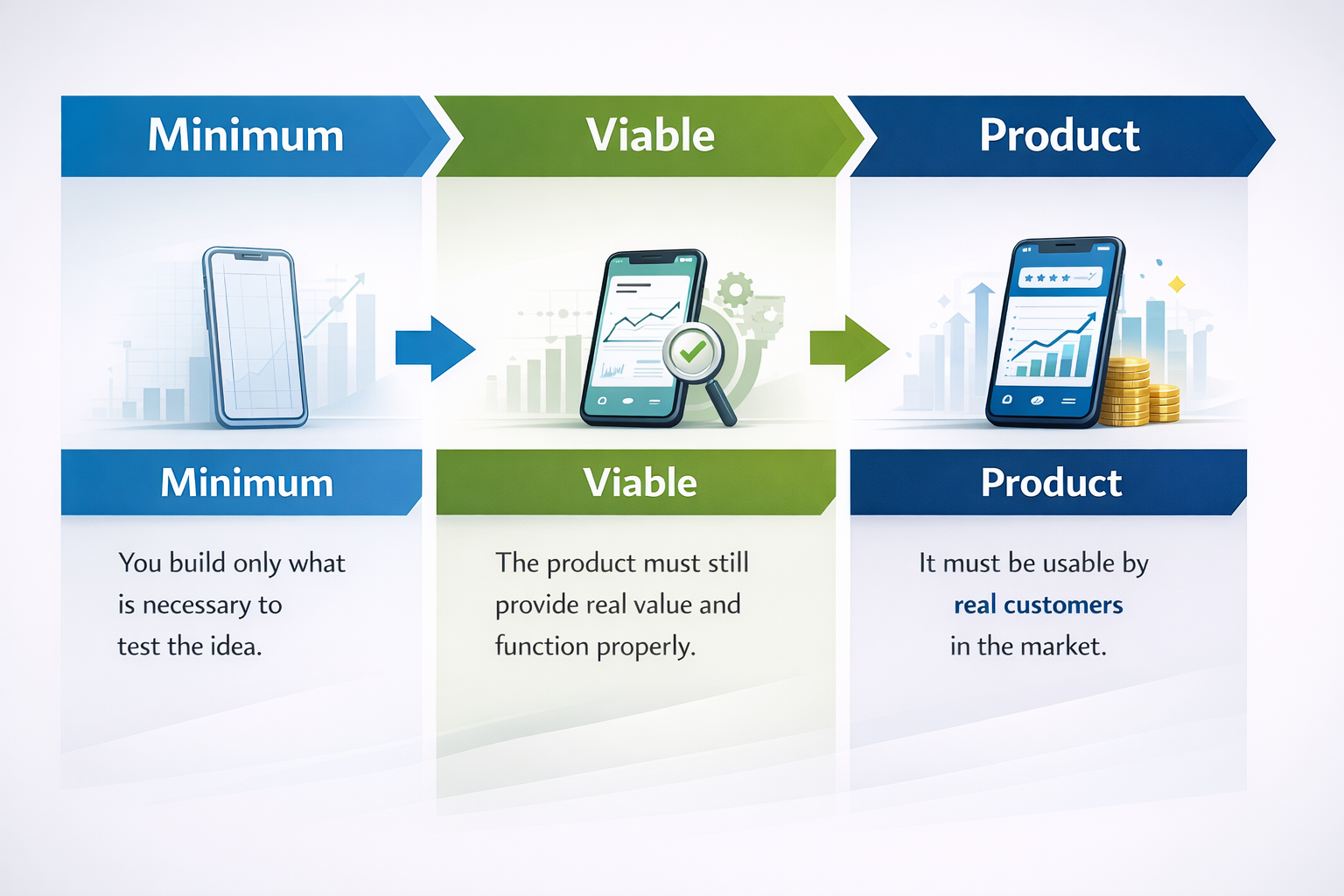
The phrase contains three key ideas.
Minimum
You build only what is necessary to test the idea.Viable
The product must still provide real value and function properly.Product
It must be usable by real customers in the market.
A common misunderstanding is that an MVP is a rough or incomplete product. A successful MVP still delivers a clear solution to a real user problem. The difference is that it focuses on the most critical features rather than everything at once.
For example, a ride hailing platform does not need loyalty programmes, in app messaging, or complex analytics during the MVP stage. The essential feature is connecting passengers with drivers.
By focusing only on what matters most, teams shorten the application development life cycle and reach the market faster.
Why Minimum Viable Products Matter in Modern Software Development
Launching a full-scale product without validating demand can be extremely risky. Many startups fail because they spend too much time and money building features users do not actually want.
The concept of the minimum viable product became widely known through the Lean Startup movement introduced by entrepreneur Eric Ries. His work explains how startups can reduce risk by testing ideas quickly instead of building full products immediately.
You can explore more insights about MVP thinking and lean startup principles on Startup Lessons Learned, where founders share strategies for validating ideas, gathering feedback, and improving products through continuous iteration.
This is why the minimum viable product approach has become a core practice in modern software development.
There are several reasons why MVP strategies are so powerful.
1. Faster Market Entry
Speed is critical in technology markets. If your idea takes two years to launch, competitors may already dominate the space.
By building an MVP first, your growth hacking team can release the product quickly and start collecting user data earlier.
2. Lower Development Costs
App development cost can increase quickly when teams attempt to build a complete platform from the beginning.
An MVP helps you control cost by focusing only on the most important functionality.
This approach allows startups to:
Allocate resources efficiently
Test the product before major investment
Reduce wasted development effort
3. Real User Feedback
Assumptions can be dangerous in startup product development. What founders believe users want may not match reality.
Launching a minimal viable product allows you to gather real insights through user behaviour and feedback.
These insights help guide the next stage of development.
4. Data Driven Product Decisions
Instead of guessing what features to build next, teams rely on data.
Many companies use lean analytics to measure how users interact with their MVP. Metrics such as engagement, retention, and conversion rates reveal whether the product delivers real value.
One key measurement is the north star metric. This is the single most important indicator of product success. It represents the value your product delivers to users.
For example:
A streaming platform might track total watch time
A marketplace might track successful transactions
A productivity app might measure tasks completed
Tracking the right metrics ensures your development priorities remain aligned with user value.
5. Reduced Risk for Startups
For early-stage startups, resources are limited. Launching a full product without validation can drain funding quickly.
An MVP reduces this risk by allowing teams to:
Test product market fit early
Validate demand before scaling
Attract investors using real user data
Investors are far more confident when a startup can demonstrate traction with an MVP rather than just presenting an idea.
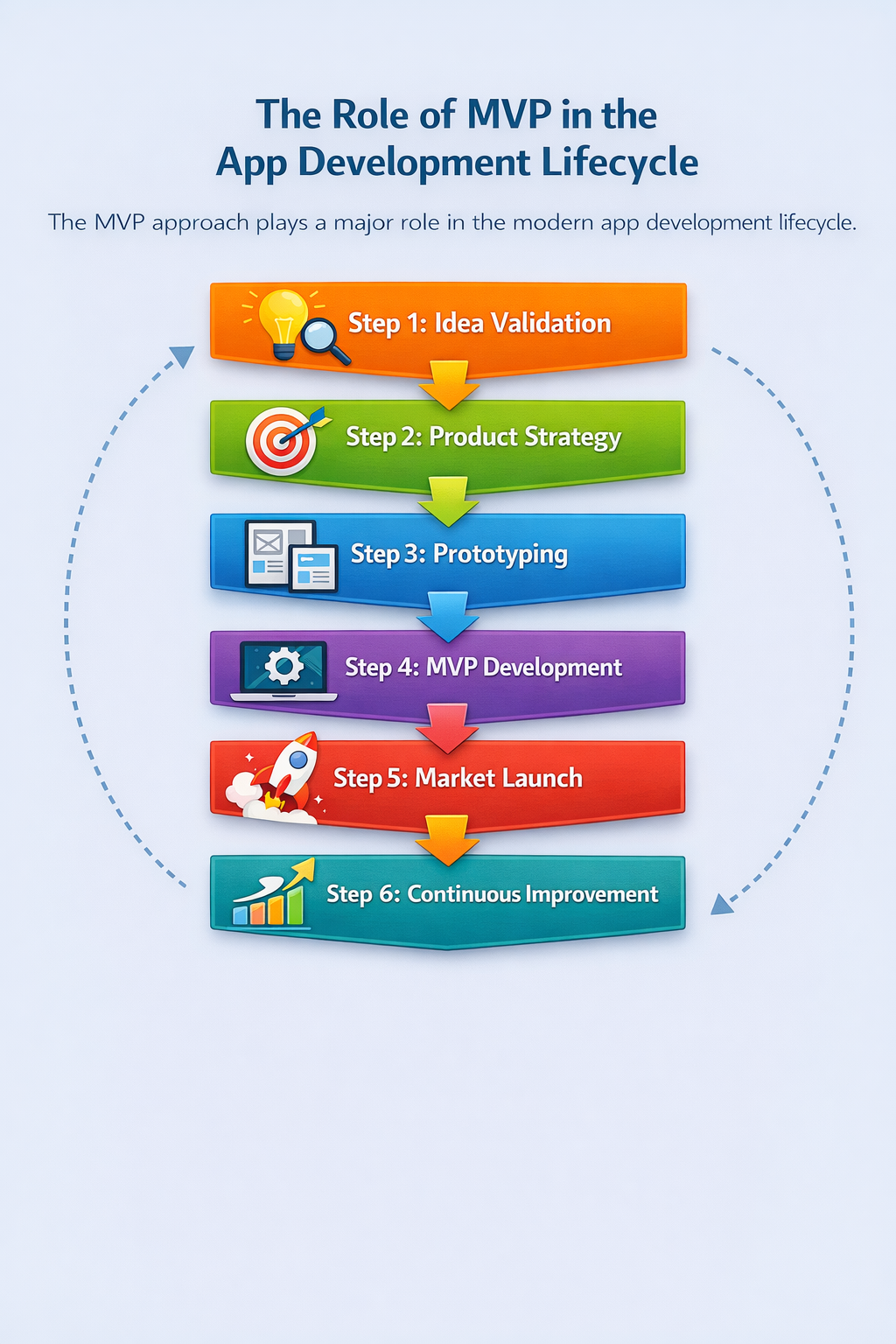
The Role of MVP in the App Development Lifecycle
Traditional software development often followed a long planning and build process before releasing anything to users. This method delayed feedback and increased project risk.
Today, many companies follow an iterative application development life cycle where the MVP is the first major milestone.
The process often looks like this.
Step 1: Idea Validation
Every product begins with a problem that needs solving.
Teams research the market, analyse competitors, and identify the target users.
At this stage, the goal is to confirm that the problem is real and worth solving.
Step 2: Product Strategy
Next, the team defines the product vision and identifies the core features required for the MVP.
Instead of listing dozens of features, the focus remains on the essential functionality that delivers the main value.
Step 3: Prototyping
Before development begins, designers often create early concepts using prototyping tools.
These prototypes help visualise how the product will work and allow stakeholders to test the user experience before coding begins.
Popular prototype tools allow teams to simulate user flows and interactions without writing software.
Step 4: MVP Development
After validation and prototyping, the development team begins building the MVP.
At this stage, the product includes:
Core functionality
Basic user interface
Essential backend systems
This is where minimum viable product software development becomes critical. The focus remains on speed, usability, and testing rather than feature completeness.
Step 5: Market Launch
Once the MVP is stable, the product is released to a limited audience.
The goal is to collect real world feedback and measure user behaviour.
Companies often release MVPs to early adopters or small user groups before a larger launch.
Step 6: Continuous Improvement
The MVP is not the final product. It is the starting point.
Teams analyse user behaviour using lean analytics and refine the product through continuous updates.
New features are introduced gradually based on actual user needs.
This iterative process allows companies to build better products while reducing development risk.
Key Characteristics of a Successful MVP
Not every early-stage product qualifies as a true MVP. A successful minimum viable product must balance simplicity with real user value.
Product strategy experts also emphasise the importance of focusing on core value during MVP development. According to guidance from ProductPlan, successful product teams prioritise features that deliver immediate user value while postponing non-essential functionality.
This approach ensures the minimum viable product remains focused on solving a specific problem while leaving room for the product to evolve based on real user demand.
If the product is too basic, users may not understand its purpose. If it contains too many features, it defeats the purpose of an MVP.
The most effective minimum viable products usually share several important characteristics.
Clear Problem Solving
An MVP must solve a specific problem for users.
Even with limited functionality, the value should be obvious from the first interaction.
Focus on Core Features
Successful MVP development focuses only on essential features.
These features directly support the main product goal and remove unnecessary complexity.
Quick Development Time
Speed is a major advantage of the MVP approach.
By limiting scope, teams shorten the application development life cycle and reach users faster.
Measurable Outcomes
A strong MVP allows teams to track meaningful metrics.
By measuring engagement and behaviour, companies can determine whether the product meets user expectations.
Scalability for Future Development
Although an MVP starts small, it should still be built on a foundation that supports future growth.
This ensures the product can evolve into a full platform as demand increases.
In the next section, we will explore the step-by-step process for building a successful MVP, along with real world examples of companies that started with simple minimum viable products before becoming global technology leaders.
Steps to Build a Minimum Viable Product for Startup Product Development
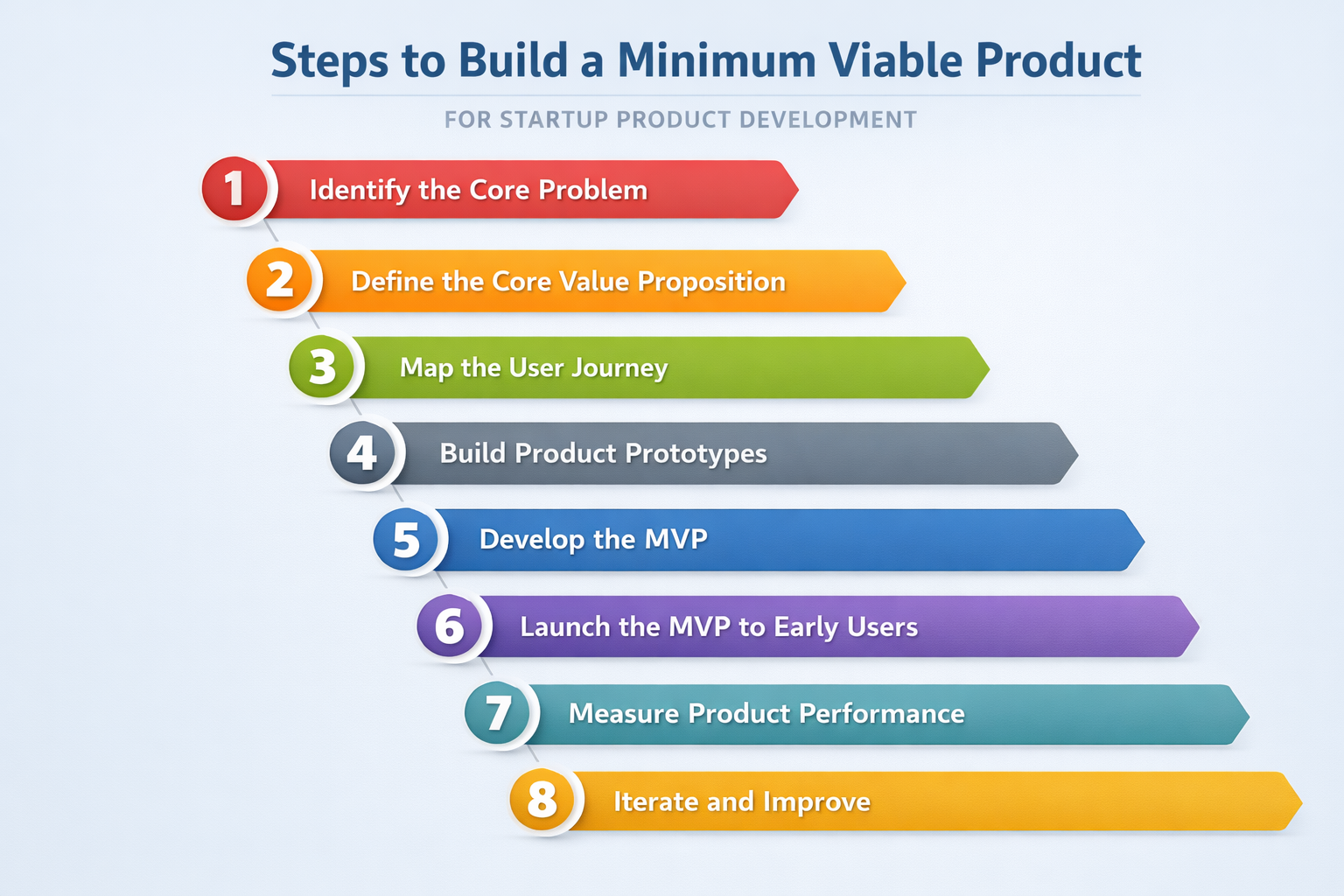
Building a minimum viable product requires a structured approach. Although the goal is to launch quickly, the process must still follow a clear strategy to ensure the product delivers value to users.
Many product leaders recommend combining MVP development with continuous product discovery. Industry resources such as Mind the Product highlight how modern product teams analyse user behaviour, test assumptions, and refine features based on real data. This approach allows minimum viable products to evolve into scalable platforms through evidence-based decision making.
Many successful companies follow a step-by-step framework when applying minimum viable product software development. This approach helps teams stay focused while reducing app development cost and shortening the application development life cycle.
Step 1: Identify the Core Problem
Every product should begin with a clear problem statement. Before building anything, you must understand what issue your product aims to solve.
Start by researching your target users. This often includes:
Analysing market demand
Studying competitor products
Interviewing potential users
Identifying gaps in current solutions
This step ensures that your startup product development efforts focus on solving a real problem rather than building unnecessary features.
Step 2: Define the Core Value Proposition
Once the problem is clear, the next step is identifying the core value your product will deliver.
This stage helps answer the question many founders ask: what is an MVP in practical terms? The answer lies in defining the single most important feature that provides value to users.
Instead of trying to build a complete system, your minimal viable product should focus on one primary function.
For example:
A food delivery platform connects customers with restaurants
A project management tool organises tasks for teams
A marketplace connects buyers and sellers
All other features can be introduced later.
Step 3: Map the User Journey
Before development begins, it is important to understand how users will interact with your product.
Teams often create a simple user journey map that outlines the steps a user takes when using the platform.
Typical stages may include:
User registration
Searching or browsing content
Performing the main action
Receiving results or confirmation
By mapping this journey, development teams can identify the minimum features required for the MVP.
Step 4: Build Product Prototypes
Before coding begins, designers typically use prototyping tools to create early visual concepts of the product.
These prototype tools simulate how users will interact with the application. They allow teams to test ideas quickly and identify design issues before entering the full software development phase.
Prototyping provides several benefits:
Faster design validation
Improved collaboration between teams
Lower development risk
Better user experience planning
Many teams combine prototyping tools with design thinking software development methods to ensure the product solves real user problems.
Design thinking focuses on understanding user needs, testing ideas rapidly, and improving solutions through continuous feedback.
Step 5: Develop the MVP
After the design and validation stages, the development team begins building the minimum viable product.
This phase of minimum viable product software development focuses only on essential functionality. The goal is to create a working product that users can interact with, not a fully featured system.
Typical components of an MVP may include:
Basic user interface
Core product functionality
Essential database or backend systems
Simple analytics tracking
For example, an early-stage web app development project may include only a few pages and basic user actions. Advanced features such as automation, integrations, and complex dashboards can be added later.
This focused approach significantly reduces app development cost while allowing companies to launch quickly.
Step 6: Launch the MVP to Early Users
Once development is complete, the MVP is released to a limited group of users.
This early release is a crucial part of the app development lifecycle because it provides real world insights into how people interact with the product.
Startups often release their MVP to:
Early adopters
Beta testing communities
Small user segments
These users provide valuable feedback that helps guide future development.
Step 7: Measure Product Performance
After launch, the focus shifts to analysing user behaviour and collecting data.
Many companies rely on lean analytics to evaluate the success of their minimum viable products. Lean analytics focuses on identifying the key metrics that indicate whether a product delivers value.
One of the most important metrics is the north star metric.
The north star metric represents the core value your product provides to users. It aligns the entire team around a single measure of success.
Examples include:
Number of successful transactions in a marketplace
Hours of content consumed on a media platform
Tasks completed in a productivity tool
Tracking the right metrics allows your growth hacking team to identify areas for improvement and prioritise new features.
Step 8: Iterate and Improve
The MVP is only the beginning of the product journey. After gathering user feedback and data, the development team begins improving the product.
New features are added gradually, guided by user needs and performance metrics.
This iterative process is a core principle of modern software development and helps companies build better products while reducing long term risk.
Real World Examples of Successful Minimum Viable Products
Many of the world's most successful technology companies began with simple MVPs.
These early versions allowed them to validate their ideas before investing heavily in development.
Airbnb
Airbnb started as a simple website created by its founders to rent out air mattresses in their apartment during a conference.
The initial minimal viable product was extremely basic. It included:
A simple listing page
Basic booking functionality
Photos of available spaces
This simple idea validated demand for short term accommodation rentals. Over time, the platform evolved into a global marketplace.
Dropbox
Dropbox provides another famous example of MVP thinking.
Instead of building a complete product immediately, the company released a short demonstration video explaining how the service would work.
This video acted as an MVP because it validated interest in the concept before full development began.
Thousands of people signed up for early access after watching the video, confirming that the idea had strong market potential.
Facebook also began as a very simple MVP.
The original platform was limited to students at one university and included only basic social networking features such as profiles and friend connections.
By starting with a focused product and expanding gradually, the company was able to refine its platform based on real user behaviour.
These examples demonstrate how minimum viable products allow startups to test ideas quickly and grow based on real market demand.
Common Mistakes When Building an MVP
Although the MVP strategy is widely used, many teams misunderstand how to apply it correctly.
Several common mistakes can prevent a minimal viable product from delivering useful insights.
Building Too Many Features
One of the most common errors is adding too many features to the MVP.
When teams attempt to include everything in the first release, the benefits of the MVP approach disappear. Development becomes slower and more expensive.
The focus should remain on core functionality.
Ignoring User Feedback
Another mistake is failing to listen to users after launch.
An MVP only provides value if the development team actively studies user behaviour and feedback.
Ignoring these insights prevents meaningful improvements.
Lack of Clear Metrics
Without measurable goals, it becomes difficult to determine whether the MVP is successful.
Teams should define key performance indicators and track them using lean analytics.
Poor User Experience
Even though the MVP contains fewer features, it should still provide a smooth user experience.
If the product is difficult to use or unreliable, users may abandon it before providing valuable feedback.
The Future of MVP Driven Product Development
As digital products become more complex, the MVP approach continues to play an important role in startup product development.
Companies are increasingly adopting agile software development practices, rapid prototyping tools, and data driven decision making to build better products faster.
For startups, launching a minimum viable product provides a practical path from idea to market validation.
For established businesses, MVP strategies allow teams to experiment with new products without committing significant resources upfront.
In today's competitive digital environment, the ability to test ideas quickly can determine whether a product succeeds or fails.
Turning Ideas into Successful Digital Products
A minimum viable product is more than just a simplified product. It is a strategic approach that helps you validate ideas, reduce app development cost, and build solutions that users need.
By focusing on core functionality, gathering real user feedback, and improving through data driven decisions, businesses can accelerate the entire application development life cycle.
Whether you are planning a startup platform, launching a new service, or exploring web app development opportunities, an MVP allows you to move from concept to market faster and with less risk.
The key is balancing speed with user value while continuously refining the product based on real insights.
If you are planning a digital product and want to build a reliable MVP, the right development partner can make the process significantly smoother.
At Trinergy Digital, we help businesses turn ideas into scalable digital platforms through strategic software development, rapid prototyping, and user focused product design.
Ready to build your minimum viable product? Contact Trinergy Digital to start your project with our team.