



Introduction
In today's competitive business landscape, digital transformation in customer experience is no longer optional. Organisations seeking growth and sustainability must adapt to rapidly changing customer expectations and technological innovations. Whether you are a B2B application provider or a B2C application developer, understanding the impact of digital transformation on customer experience is crucial.
Businesses are increasingly focusing on digital customer engagement, leveraging AI integrations, and adopting integrated software solutions to improve customer interactions. However, the journey is not without obstacles. Companies face digital transformation challenges, including software security concerns, scalability issues, and ensuring seamless experiences across web and mobile platforms.
This article explores practical strategies that work, guiding you through the process of implementing a customer engagement transformation that is both effective and secure.
Understanding Digital Transformation in Customer Experience
Digital transformation customer experience refers to the use of modern digital technologies to improve how customers interact with your business. It goes beyond simply upgrading software; it involves rethinking processes, integrating new tools, and enhancing the overall journey of the customer.
A successful customer digital transformation ensures that every touchpoint, from initial awareness to post-purchase support, is optimised for convenience, speed, and relevance. This can include:
AI-powered chatbots for instant support
Personalised recommendations in web and mobile apps
Secure applications for sensitive transactions
Data-driven insights for understanding customer behaviour
The impact of digital transformation on customer experience is measurable. Businesses adopting these strategies often report higher customer satisfaction, increased engagement, and stronger loyalty. For example, a B2B application that integrates AI analytics can provide clients with predictive insights, improving decision-making and strengthening the business relationship.
Key Drivers of Customer Digital Transformation
Several factors drive the push towards digital transformation in customer experience:
1. Rising Customer Expectations
Modern customers expect instant responses, personalised solutions, and seamless interactions. The proliferation of mobile devices and high-speed internet means that delays or friction in digital touchpoints can lead to customer churn.
A well-planned digital transformation customer experience strategy addresses these expectations by providing integrated solutions that are easy to use, responsive, and secure. For instance, a mobile app development project that prioritises speed and usability will attract and retain customers more effectively.
2. Technological Advancements
Technologies such as AI, cloud computing, and advanced analytics enable businesses to understand and respond to customers in real time. AI integration can automate routine tasks, predict customer needs, and personalise interactions, while integrated AI tools ensure that all systems communicate efficiently.
Software and web app developers increasingly leverage these technologies to build secure applications with high scalability, ensuring businesses can adapt as customer demand grows.
3. Competitive Pressure
Companies that lag in digital customer engagement risk losing market share. Competitors investing in customer engagement transformation can offer faster, more reliable services, setting higher expectations for the entire industry.
Engaging with a trusted software development company can provide the technical expertise necessary to implement these solutions effectively, whether for a B2B application or a B2C application.
4. Regulatory and Security Requirements
With increasing regulatory standards around data privacy and software security, businesses must ensure that their digital platforms comply with legal requirements. Implementing robust software security protocols not only protects customers but also builds trust and strengthens your brand reputation.
Strategies for Enhancing Digital Customer Engagement
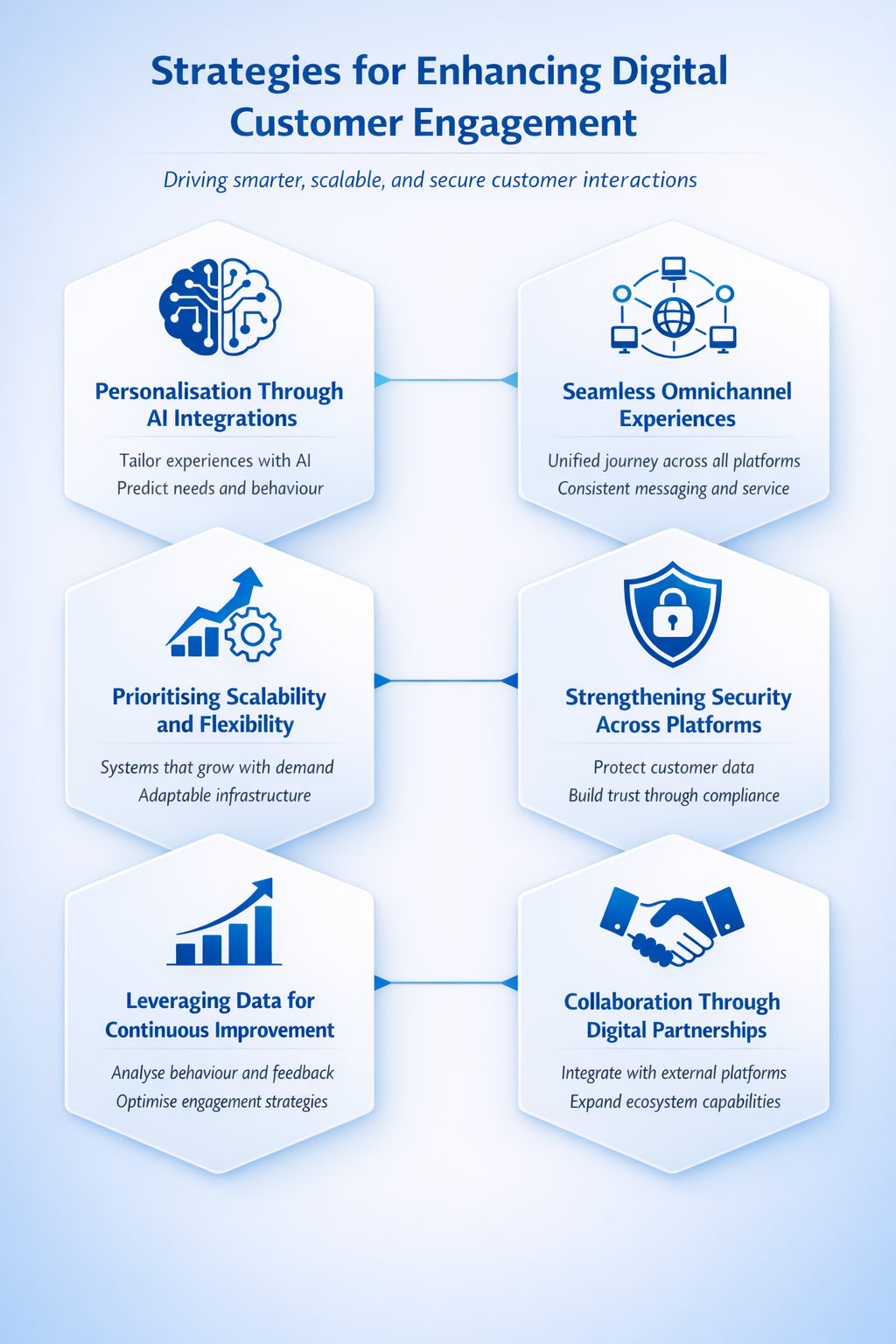
Implementing a successful digital transformation in customer experience requires a combination of strategy, technology, and process optimisation. Here are proven approaches:
1. Personalisation Through AI Integrations
Customers increasingly expect experiences tailored to their preferences. AI integrations allow businesses to analyse user behaviour, predict needs, and deliver personalised recommendations.
For example, a web app development project for a retail client can include AI-driven product suggestions, improving both engagement and conversion rates. In mobile app development, AI can personalise notifications, ensuring customers receive relevant updates without feeling overwhelmed.
2. Seamless Omnichannel Experiences
Customers interact with businesses across multiple channels, including websites, mobile apps, social media, and in-store. Achieving a customer engagement transformation requires integrating these channels into a single, cohesive experience.
Digital partnerships with other technology providers can enhance your capabilities. For instance, integrating payment gateways, CRM systems, and marketing automation tools ensures that customers experience consistency, regardless of the platform they use.
3. Prioritising Scalability and Flexibility
A common digital transformation challenge is building systems that can grow with the business. Scalability ensures that your digital platforms can handle increasing traffic, transactions, and data without compromising performance.
Engaging a skilled software development company can help design scalable solutions in both B2B applications and B2C applications, ensuring long-term sustainability. This includes robust web app development and mobile app development practices that can adapt to evolving business needs.
4. Strengthening Security Across Platforms
As businesses embrace digital transformation, software security becomes a critical concern. Customers need reassurance that their data is safe, and regulatory bodies demand compliance with strict data protection standards.
Strategies for enhancing security include:
Implementing secure authentication protocols
Encrypting sensitive customer data
Conducting regular vulnerability assessments
Integrating secure payment processing in mobile and web apps
By focusing on secure applications, businesses not only protect their clients but also build credibility and trust.
5. Leveraging Data for Continuous Improvement
Effective customer digital transformation relies on data-driven insights. By tracking user behaviour, engagement patterns, and feedback, businesses can continuously refine the customer journey.
AI integration enables predictive analytics, allowing organisations to anticipate customer needs and act proactively. This is particularly valuable for B2B applications, where anticipating client requirements can strengthen partnerships, and for B2C applications, where it can enhance personalised experiences.
6. Collaboration Through Digital Partnerships
Many companies lack the in-house expertise required for advanced digital initiatives. Forming digital partnerships with experienced software developers, AI specialists, and technology providers can accelerate transformation and reduce risk.
These collaborations ensure access to the latest innovations in integrated AI, software development, and secure applications, allowing your organisation to focus on delivering superior customer experiences while partners handle complex technical implementations.
Overcoming Digital Transformation Challenges
While the benefits of digital transformation customer experience are clear, businesses often face obstacles that can slow progress. Common digital transformation challenges include:
Resistance to change among staff or management
Legacy systems that are difficult to integrate
Ensuring software security across multiple platforms
Managing costs and return on investment
Maintaining scalability as customer demand grows
Addressing these challenges requires a structured approach:
Assess Readiness - Evaluate your current systems, team capabilities, and customer expectations.
Develop a Roadmap - Prioritise initiatives based on impact and feasibility.
Engage Experts - Partner with a reliable software development company for technical expertise.
Pilot Projects - Test new tools and processes with a small segment before full deployment.
Monitor and Adapt - Continuously measure the impact of your initiatives and adjust strategies as needed.
For example, integrating AI into an existing web app development project might initially face technical hurdles. By starting with a pilot program, businesses can identify potential issues and optimise integrated AI features before a wider rollout.
Real World Examples of Successful Digital Transformation in Customer Experience
To understand the effectiveness of a customer engagement transformation, it is useful to look at real-world examples where digital initiatives have improved customer experiences.
1. AI Integration in B2C Applications
Retail companies have successfully leveraged AI integrations to personalise shopping experiences. By analysing user behaviour on mobile and web apps, these platforms recommend products and services tailored to individual preferences.
For example, a B2C application employing integrated AI can send personalised notifications about discounts or product launches, improving engagement and driving repeat purchases. AI-driven chatbots also provide instant customer support, reducing response times and improving satisfaction.
2. Digital Transformation in B2B Applications
In B2B contexts, digital transformation customer experience often focuses on streamlining communication and automating processes. For instance, a B2B application that integrates predictive analytics can forecast client needs and provide actionable insights, enhancing the business relationship.
A software development company specialising in B2B solutions can implement scalable, secure platforms that handle sensitive client data while enabling seamless collaboration. By focusing on digital customer engagement, businesses can strengthen loyalty and differentiate themselves from competitors.
3. Web and Mobile App Development as a Growth Driver
Modern web app development and mobile app development initiatives play a pivotal role in digital transformation. By offering intuitive, responsive platforms, businesses can improve accessibility and interaction for all customer segments.
For instance, integrating secure payment gateways, real-time analytics, and AI-powered recommendations ensures that both B2B and B2C customers enjoy a frictionless experience. These capabilities also make it easier for organisations to scale operations as demand grows, addressing one of the key digital transformation challenges.
Advanced Strategies for a Successful Customer Engagement Transformation
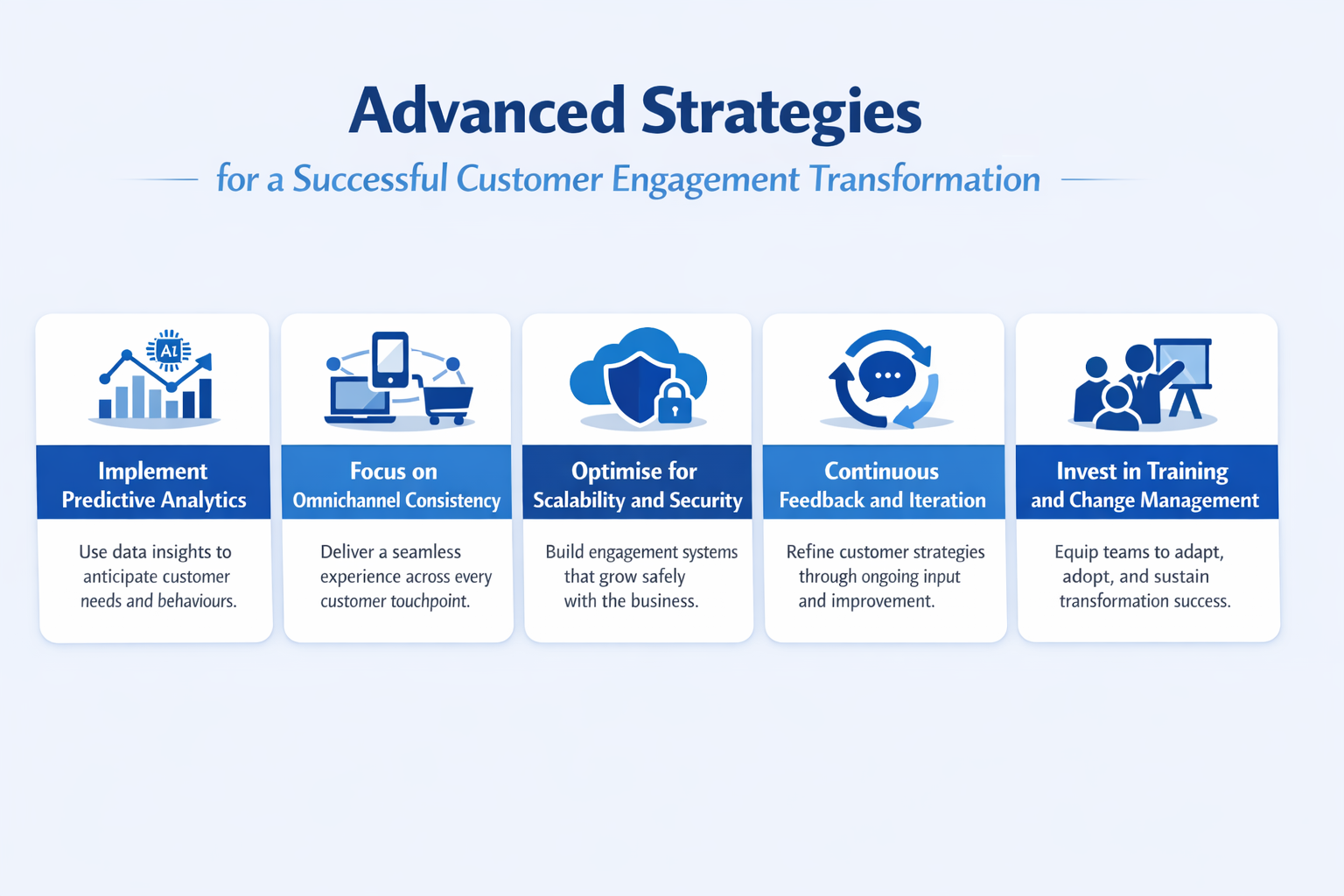
Beyond the basics, businesses can adopt advanced strategies to maximise the impact of digital transformation on customer experience.
1. Implement Predictive Analytics
AI integration enables predictive analytics, allowing organisations to anticipate customer behaviour and preferences. For example, a B2C application can predict which products a user is likely to purchase next and tailor offers accordingly. Similarly, a B2B application can forecast client needs, helping account managers deliver proactive solutions.
2. Focus on Omnichannel Consistency
Seamless experiences across platforms remain critical. Customers expect continuity whether interacting via mobile apps, web portals, or in-store interfaces. Customer digital transformation strategies should integrate CRM systems, marketing tools, and support channels, ensuring consistent messaging and service quality.
Digital partnerships with specialised vendors can accelerate this integration. For example, working with an AI solutions provider can enable unified data processing and insights, creating a smoother customer journey.
3. Optimise for Scalability and Security
As customer expectations evolve, platforms must remain scalable and secure. Companies should consider:
Cloud-based infrastructure for flexible scaling
Secure authentication and data encryption
Continuous monitoring for vulnerabilities
By prioritising software security alongside scalability, businesses can maintain customer trust while growing their digital footprint. This is especially important for B2B clients who handle sensitive information and rely on secure applications for daily operations.
4. Continuous Feedback and Iteration
A successful digital transformation in customer experience is never static. Collecting feedback through surveys, user analytics, and direct interactions helps businesses identify pain points and implement timely improvements.
Integrated AI tools can automate this analysis, highlighting trends and suggesting enhancements. For instance, a mobile app development project can automatically track usage patterns, helping developers optimise navigation and functionality.
5. Invest in Training and Change Management
Digital transformation challenges often arise from resistance within the organisation. To overcome this, companies should invest in employee training, clear communication, and change management strategies. Ensuring that staff understand the purpose and benefits of new technologies increases adoption and effectiveness.
Emerging Trends in Digital Customer Engagement
Many organisations are still figuring out how to deliver consistent experiences across multiple channels. As Gartner notes in its research on digital customer experience, businesses that focus on seamless and personalised interactions tend to see higher customer loyalty and satisfaction.
The field of digital customer engagement is rapidly evolving, and staying ahead requires awareness of emerging trends:
AI and Machine Learning
The power of AI to transform engagement cannot be overstated. According to Forrester, companies that strategically implement AI integrations in customer-facing platforms report significant improvements in personalisation and responsiveness, which ultimately drives stronger customer relationships.
Hyper-Personalisation
Beyond basic customisation, hyper-personalisation uses real-time data to adapt every interaction. For example, a B2C application can dynamically adjust content and offers based on location, purchase history, and engagement behaviour.
Voice and Conversational Interfaces
Voice-enabled apps and conversational AI are reshaping digital transformation customer experience. These interfaces offer natural, hands-free interactions, enhancing accessibility and convenience.
Security-First Design
As threats increase, software security is central to all digital transformation strategies. From secure payment systems to data privacy compliance, businesses must design secure applications from the ground up, especially in web app development and mobile app development.
Collaborative Digital Partnerships
Organisations increasingly rely on digital partnerships to access specialised expertise. Whether integrating AI, building scalable platforms, or enhancing security, collaborating with experienced vendors ensures faster deployment and better outcomes.
Best Practices for Implementing Digital Transformation in Customer Experience
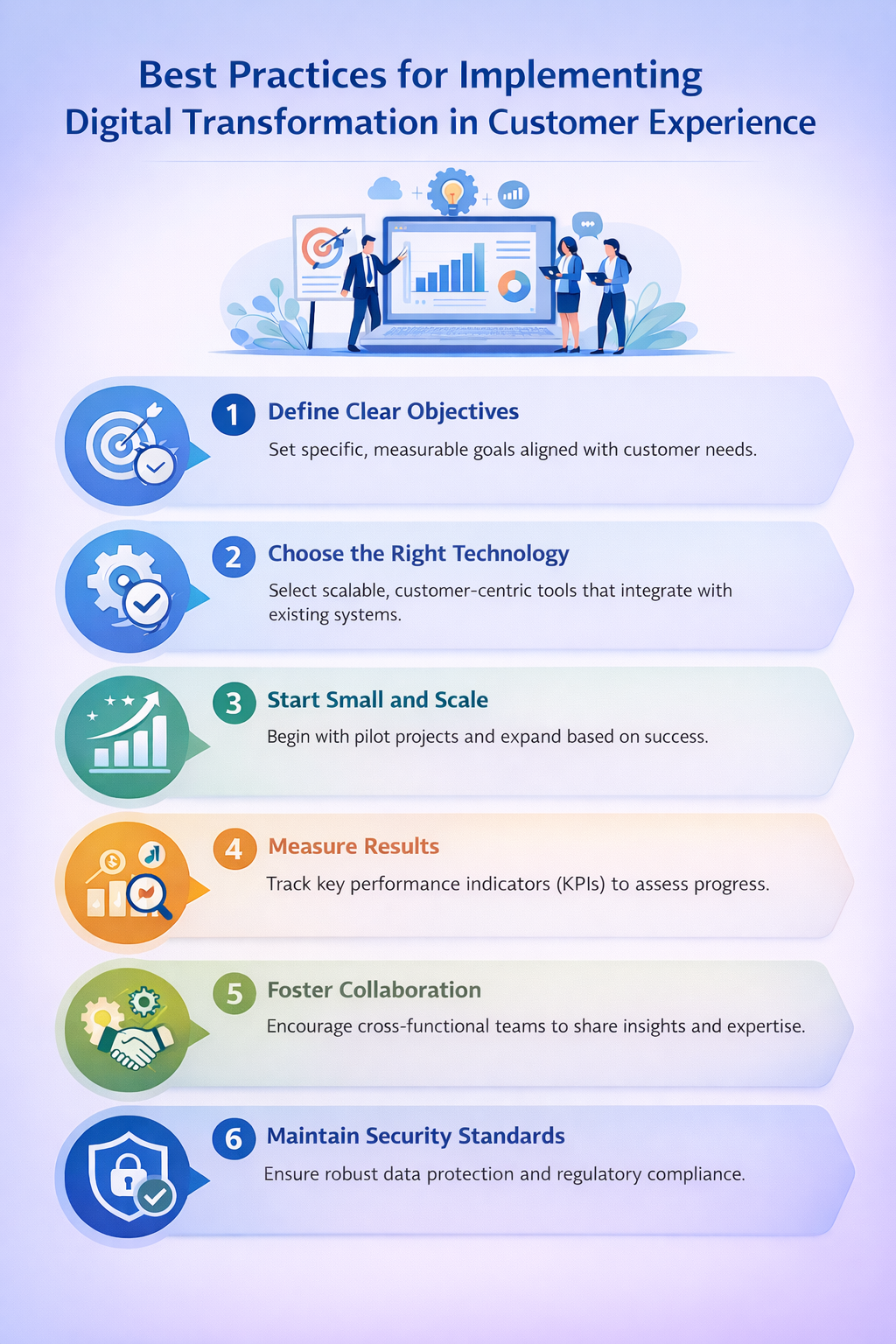
Based on industry experience, the following practices help maximise success:
Define Clear Objectives - Identify what you want to achieve with customer digital transformation, whether improving engagement, reducing churn, or increasing sales.
Choose the Right Technology - Select platforms that support AI integration, scalability, and secure operations.
Start Small and Scale - Pilot new features before full deployment to manage risks and gather insights.
Measure Results - Track KPIs such as customer satisfaction, engagement rates, and conversion metrics.
Foster Collaboration - Encourage cross-functional teams and leverage digital partnerships for expertise in software development.
Maintain Security Standards - Regularly review software security and compliance to protect customer data.
These practices are applicable to both B2B applications and B2C applications, ensuring that all customer segments benefit from your digital transformation initiatives.
Driving ROI Through Digital Transformation
Investing in digital transformation customer experience can deliver measurable returns:
Increased customer satisfaction and loyalty
Higher engagement through digital customer engagement strategies
Reduced operational costs via automation and AI
Scalable platforms that support growth without major additional investment
Enhanced reputation and trust due to secure applications and compliance
By partnering with a trusted software development company, businesses can ensure that both web app development and mobile app development projects are executed efficiently, with integrated AI and scalability in mind.
Businesses looking to maximise the benefits of digital transformation can take cues from McKinsey research, which emphasises the importance of aligning technology adoption with clear customer-focused objectives to achieve measurable impact on both engagement and operational efficiency.
Conclusion: Transforming Customer Experience for the Digital Age
The landscape of customer engagement is evolving rapidly. Successful organisations recognise that digital transformation in customer experience is not just about technology-it is about creating meaningful, secure, and scalable interactions that meet the expectations of modern customers.
From AI integrations and digital customer engagement strategies to secure B2B applications and responsive mobile app development, the potential for impact is significant. By addressing digital transformation challenges, leveraging digital partnerships, and maintaining a focus on customer-centric design, your business can stay ahead of the curve.
Digital transformation is an ongoing journey. By continuously monitoring performance, adapting to new technologies, and prioritising software security, businesses can ensure that every touchpoint contributes to a superior customer experience.
For organisations ready to embrace change and drive measurable results, partnering with an experienced software development company is a strategic step toward a successful customer engagement transformation.
For a tailored approach to your digital transformation in customer experience, connect with Trinergy Digital today and start your customer engagement transformation journey.