



Introduction to AI workflow automation
AI workflow automation is changing how businesses operate by reducing manual work and improving efficiency across daily processes. Companies now use AI workflow automation to streamline repetitive tasks and improve decision making.
Key reasons businesses adopt automation:
Reduce manual workload and save time
Improve accuracy in repetitive tasks
Speed up business operations
Lower operational costs
Improve scalability as the company grows
Business process automation AI is now widely used in areas such as data entry, customer support, reporting, and approvals. Many organisations see automation for companies as a core part of digital transformation rather than an optional upgrade.
Using AI business automation tools helps businesses standardise processes and reduce human error. This leads to more consistent output and better operational control.
How AI improves business process automation
Traditional automation follows fixed rules. AI automation platforms go further by analysing data and improving decisions over time. This makes AI workflow tools more flexible and intelligent.
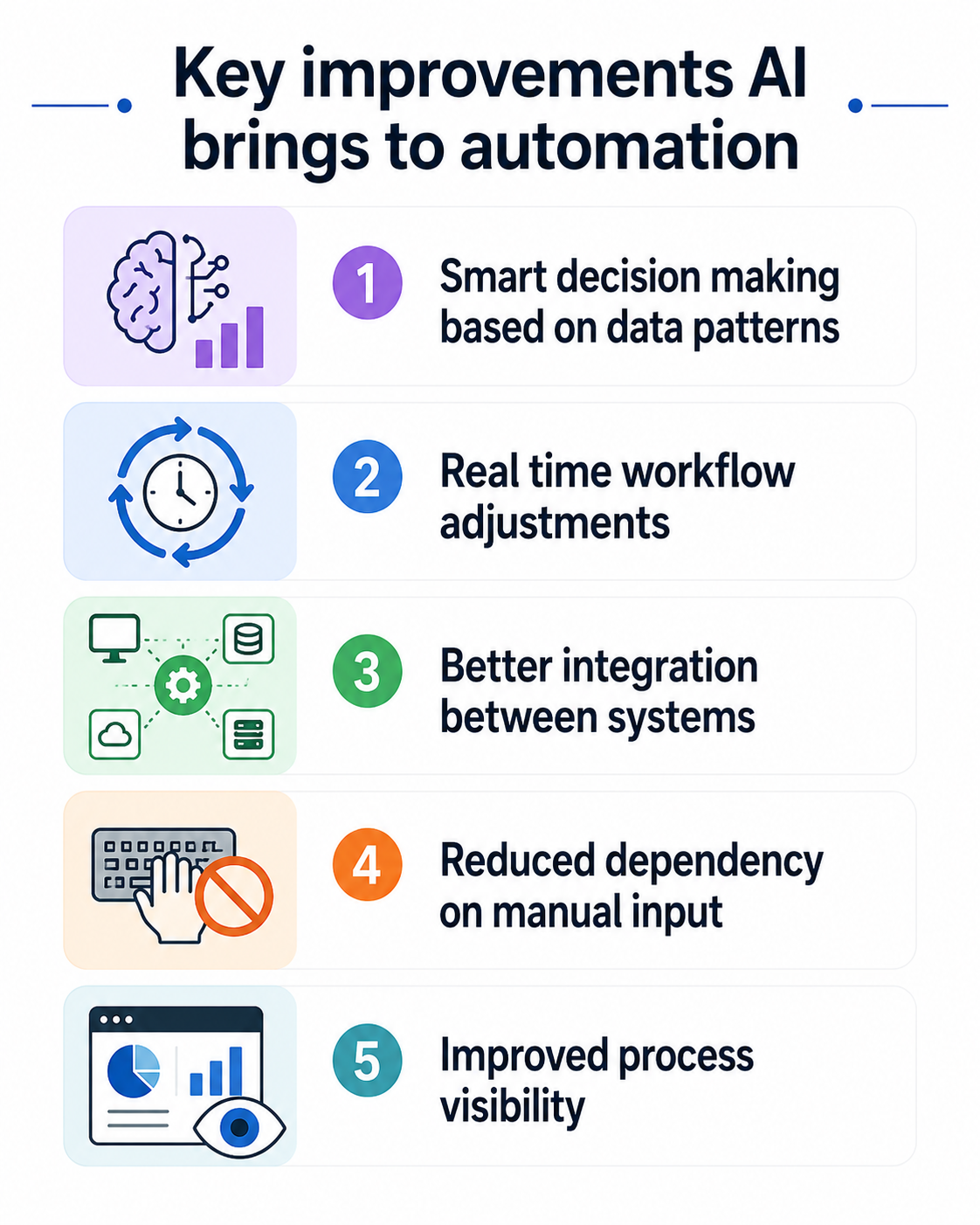
Key improvements AI brings to automation:
Smart decision making based on data patterns
Real time workflow adjustments
Better integration between systems
Reduced dependency on manual input
Improved process visibility
With AI integration automation, businesses can connect tools like CRM systems, ERP platforms, and communication apps into one unified workflow. This removes data silos and improves efficiency.
Common AI automation benefits include:
Higher productivity
Lower operational costs
Faster task completion
Fewer errors in workflows
Better use of employee time
AI automation examples in business
Common AI use cases automation include:
Customer service automation using chatbots and ticket routing
Financial automation for invoices and reporting
HR onboarding automation for document handling and task assignment
Marketing automation for email campaigns and segmentation
IT automation for system monitoring and incident response
These workflow automation systems help businesses scale operations without increasing workload at the same rate.
Key AI workflow tools and platforms
The number of AI automation tools list options is growing quickly as more companies adopt digital transformation strategies.
Main categories of AI automation platforms:
No code workflow builders for non-technical users
Enterprise automation systems for large organisations
AI analytics tools for reporting and insights
Customer engagement automation tools
Operations focused AI automation tools
Modern AI digital workflows are designed to be easy to use, even for non-technical teams. This allows faster adoption across departments such as HR, finance, and marketing.
When choosing AI productivity tools business solutions, companies should focus on:
Ease of integration with existing systems
Ability to scale with business growth
Flexibility for different workflows
Security and data protection
User friendliness for teams
A strong AI implementation strategy usually starts with:
Identifying repetitive tasks
Mapping current workflows
Selecting high impact processes
Testing automation in phases
Scaling across departments
As more companies adopt AI automation for companies, the focus is shifting from basic automation to measurable performance improvements such as efficiency gains, cost savings, and automation ROI.
Measuring automation ROI in business
Understanding the impact of AI workflow automation goes beyond efficiency gains. Businesses need to measure financial and operational outcomes to justify investment. This is where automation ROI becomes a key performance indicator.
Most organisations evaluate ROI using a combination of cost savings, time savings, and productivity improvements.
Key ROI measurement areas include:
Reduction in manual labour costs
Faster completion of business processes
Lower error related costs and rework
Improved employee productivity
Increased output without additional hiring
For example, companies using business process automation AI in finance departments often report faster invoice processing cycles and fewer payment delays. In customer service, automation reduces ticket resolution time while maintaining consistent service quality.
Microsoft's WorkLab report on a UK government Copilot study, where 20,000 employees used Microsoft 365 Copilot for three months and reported saving more than 25 minutes per day on average, with over 70% spending less time on routine tasks. This shows that AI automation tools can produce measurable efficiency improvements within the first few months of deployment.
Advanced AI use cases automation across industries
As adoption matures, AI automation is no longer limited to basic task handling. Businesses now apply AI workflow tools across complex, high value operations.
Advanced AI use cases automation include:
Predictive maintenance in manufacturing using real time sensor data
Fraud detection systems in financial services using behavioural analysis
Dynamic pricing models in e commerce based on demand patterns
Supply chain optimisation using predictive analytics
Personalised customer journeys in digital marketing platforms
These examples show how AI digital workflows are evolving into strategic business assets rather than simple task automation tools.
In healthcare, AI automation platforms are used to manage patient scheduling, medical record processing, and diagnostic support. In retail, AI efficiency tools help optimise inventory management and demand forecasting.
The expansion of automation for companies into these areas highlights the growing importance of intelligent systems that can adapt to complex environments.
Implementation strategy for AI automation success
A successful AI implementation strategy requires careful planning and structured execution. Businesses that rush adoption often face integration issues or low user adoption rates.
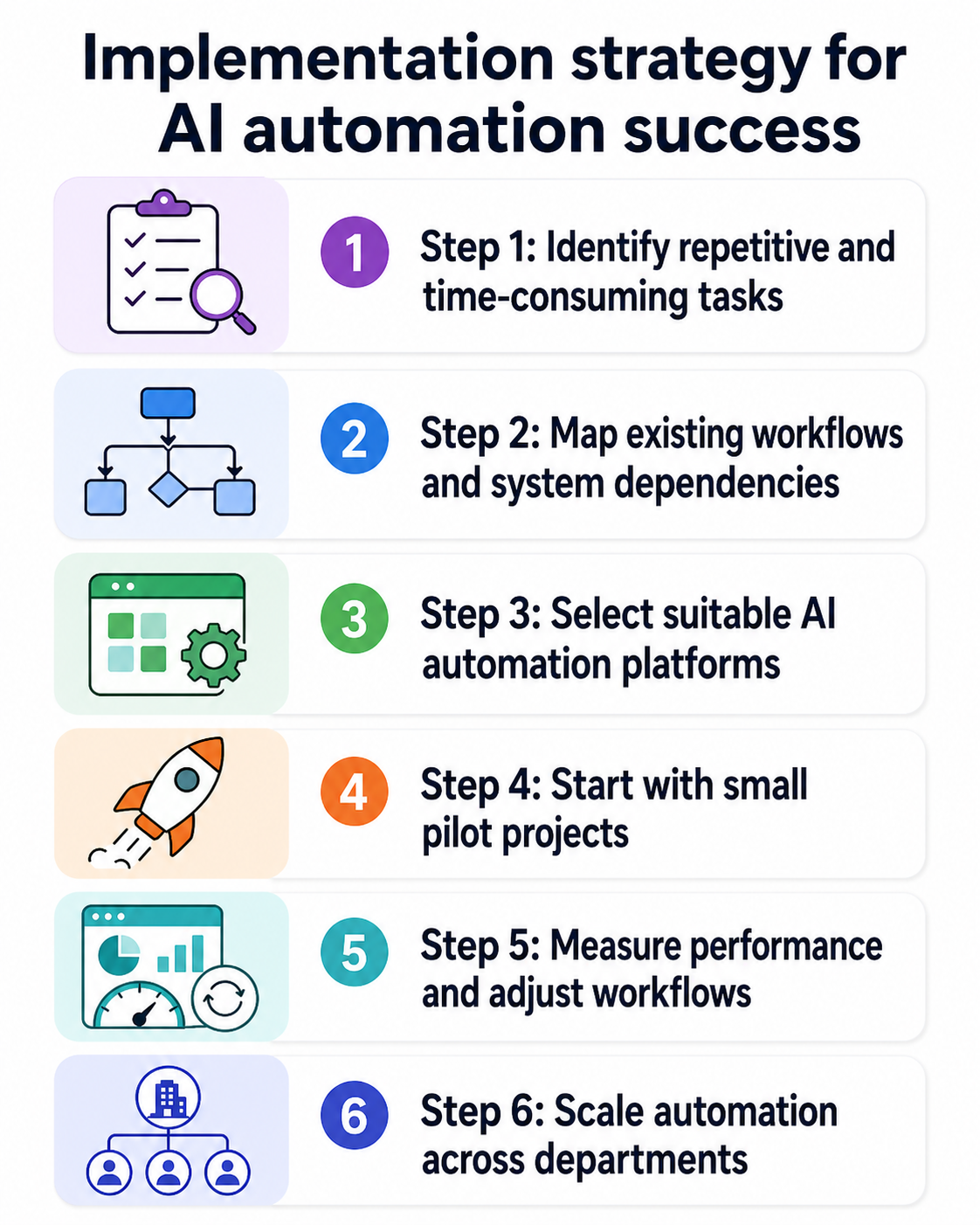
Step by step implementation approach:
Step 1: Identify repetitive and time-consuming tasks
Step 2: Map existing workflows and system dependencies
Step 3: Select suitable AI automation platforms
Step 4: Start with small pilot projects
Step 5: Measure performance and adjust workflows
Step 6: Scale automation across departments
A phased approach ensures smoother adoption and reduces operational disruption. It also allows teams to gradually adapt to AI software automation without overwhelming existing processes.
Strong AI integration automation is essential during this stage. Systems must connect seamlessly with existing tools such as CRM, ERP, and internal communication platforms to ensure consistent data flow.
Challenges and best practices in AI workflow automation
While AI workflow tools offer significant benefits, businesses may face challenges during implementation.
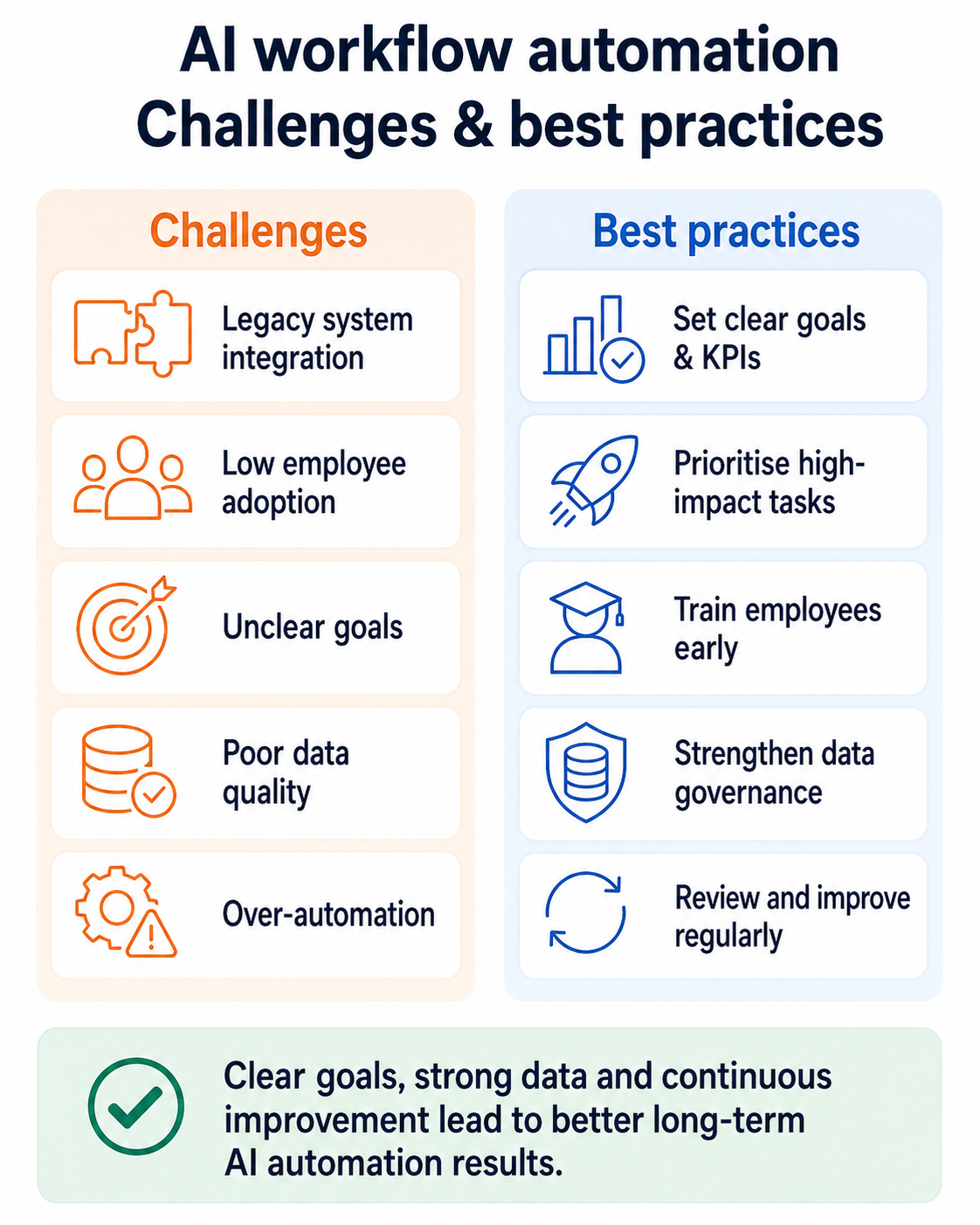
Common challenges include:
Poor integration with legacy systems
Lack of employee training and adoption
Unclear automation goals
Data quality issues
Over automation of unnecessary processes
Best practices to overcome these challenges:
Start with clear objectives and measurable KPIs
Focus on high impact processes first
Train employees early in the process
Ensure strong data governance practices
Continuously review and improve workflows
Organisations that follow these practices tend to achieve stronger results from AI automation tools list implementations and experience more stable long-term performance.
Driving long term value with AI workflow automation
The long-term value of AI workflow automation lies in continuous improvement rather than one time deployment. Businesses that treat automation as an ongoing strategy achieve higher returns and greater operational resilience.
As AI productivity tools business solutions evolve, companies gain access to more advanced capabilities such as predictive analytics, autonomous decision making, and real time optimisation.
To maximise value, organisations should:
Continuously refine automated workflows
Expand automation into new departments
Monitor automation ROI regularly
Invest in scalable AI operations tools
Align automation with business growth goals
Ultimately, AI automation for companies is not just about replacing manual work. It is about building smarter systems that improve over time and support long term digital transformation.